



 1 / 6
Newborn Genetic Screening
A simple oral-swab screening test of 258 genes linked to inherited conditions that can affect babies, including metabolic disorders, immune deficiencies and some causes of hearing loss, some of which can be treated or managed more effectively when they are found early. It is an additional private test: it does not replace the NHS newborn blood spot test, and it is a screening test, not a diagnosis.
The logistics, simply.
Everything you need to know about shipping, blood draw, and suitability.
Kit delivery & logistics
Kit delivery & logistics
1. Get your kit from us. Free delivery of your test kit, dispatched by next-day delivery after your included 45-minute specialist genetic counsellor consultation and once your test choice is confirmed. Changed your mind? Return the kit unused within 30 days at no charge.
2. Posting your sample back. After sample collection, send your sample in the pre-paid bag to the nearest depot (details in your email). Turnaround is counted from when your sample reaches the laboratory.
Sample / draw options
Sample / draw options
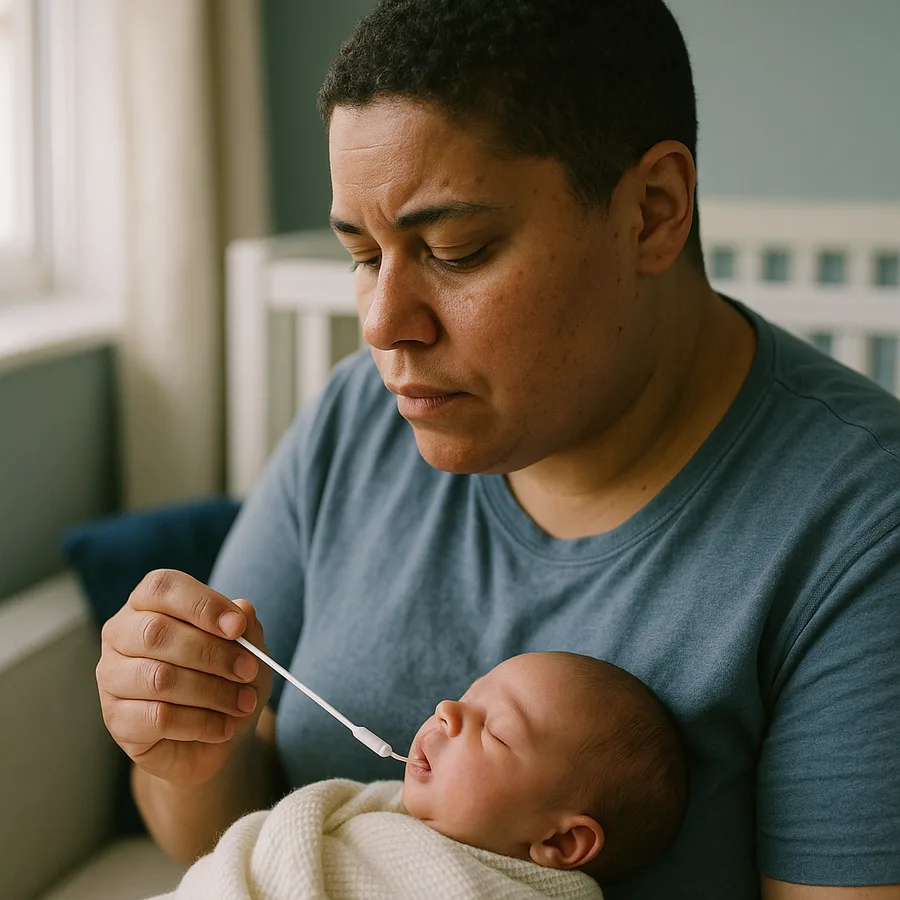
At-home cheek swab : At-home cheek swab kit; you collect the sample yourself and post it back.
Test suitability
Test suitability
This test is for babies under 12 months old who have no symptoms. A baby who is already unwell or has symptoms needs a diagnostic assessment rather than a screening test: email [email protected] and we will arrange the right next step.
The order must be placed by a parent or legal guardian aged 18 or over, who gives consent on the baby's behalf and completes a pre-test consultation with one of our genetic counsellors. You collect your baby's cheek swab at home.
Three steps. That's it.
Simple, clinician-supported steps to take your test with Jeen.
Talk to a clinician
Book your included 45-minute consultation with our specialist genetic counsellor. Confirm the test that's right for you.
Consent + collect
Complete your consent form online, receive your kit, and collect your baby's cheek swab at home.
Results + follow-up
Your results are reviewed by your genetic counsellor. We share them with you securely, and book a follow-up consultation with onward referrals if your result is high-risk.
Compare every option we offer.
Price, turnaround and coverage side by side.


200+ collection points across the UK
If you choose a clinic blood draw, you can pick a collection point near you on the map.
This map is served by Google Maps, which sets its own cookies on your device.
Partner clinics are also listed below. How we use cookies
Frequently asked questions.
What does Newborn Genetic Screening test for?
When should we test our newborn?
Is the test painful or invasive?
How long do results take?
How much does Newborn Genetic Screening cost?
Does this replace the NHS newborn blood spot test?
What can this test not tell us?
Who can order this test?
All 258 genes by category
Genes grouped by the clinical area they're associated with. Click any underlined symbol to read the gene's plain-English overview on Jeen Library - or browse per-gene carrier frequencies for population-stratified rates.
References & methodology
Figures in the GUARDIAN sub-sections come from one US research study, not from this test.
The GUARDIAN study
GUARDIAN (Genomic Uniform-screening Against Rare Disease in All Newborns) offered genome-sequencing-based newborn screening to families at six hospitals in New York City. Its first published results (Ziegler et al., JAMA, 2025) cover the first 4,000 babies enrolled:
- Sequencing was completed for 3,982 babies. 147 babies (3.7%) had a positive screen, and 120 of the 151 positive screen results were confirmed as true positives.
- The most common positive screen was G6PD deficiency, found in 92 babies. Leaving G6PD deficiency out, the screen-positive rate was about 0.6%, compared with about 0.3% for routine newborn screening in New York State.
- GUARDIAN screened 156 early-onset conditions with established interventions, plus 99 optional neurodevelopmental conditions.
Why those figures do not carry over to this test
- GUARDIAN was a research study in one diverse US city. The frequency of conditions such as G6PD deficiency and haemoglobin disorders differs between populations, so the UK figures would be different.
- This 258-gene panel is not the same panel. Some conditions in GUARDIAN are not covered here, and the conditions listed above under each gene category are examples of what the genes can detect, not a complete list.
- The authors note that the study cannot yet identify false-negative results, so how reliable a negative result is has not been established.
- A positive screening result is not a diagnosis. It needs confirming with a diagnostic test arranged through a specialist service.
Alongside NHS newborn screening
This test does not replace the NHS newborn blood spot (heel-prick) test, which is recommended for all babies. The NHS test screens for 10 rare but serious conditions - sickle cell disease, cystic fibrosis, congenital hypothyroidism, phenylketonuria, medium-chain acyl-CoA dehydrogenase deficiency, maple syrup urine disease, isovaleric acidaemia, glutaric aciduria type 1, homocystinuria and hereditary tyrosinaemia type 1 - and is usually done when a baby is 5 days old. Please take up the NHS test as well.
Citations:
- Ziegler A, et al. "Expanded Newborn Screening Using Genome Sequencing for Early Actionable Conditions." JAMA. 2025;333(3):232-240. doi:10.1001/jama.2024.19662. Open in PubMed →
- NHS England. "Newborn blood spot screening: programme overview." GOV.UK →
Talk to a specialist.
Our team is here to help. Whether you're curious about testing, your results, or what's right for you - we're a message away.
Book a consultationQuick check before you order
Two short questions - newborn genetic screening is a screening test for asymptomatic babies under 12 months. If either answer rules that out, we'll route you to the right pathway instead.
Email [email protected] and we'll arrange the right next step.